

Not all people want to be in front of the camera. Some people don’t even consider going on YouTube for this one reason alone. Thinking that only personalities who are willing to put their face out there and speak straight into a camera can be successful. That’s not the case anymore. All that is eliminated with a faceless YouTube channel.
No camera presence, no selfie, just content around voiceover, visuals, footage or animation. There are a lot of successful channels that operate this way, and make money from ads, affiliate links, and sponsorships without ever showing their faces.
This is a guide to the realities of having an YouTube channel without a face, to choosing a format, and to making it a sort of passive income in the long run.
What a Faceless YouTube Channel Really Means
The concept is a more encompassing time than people think. It isn’t necessarily just stock footage with narration, but it’s one popular way to do it. It can be animated explainers, screen recordings, slideshow-style videos, videos with text on screen and background music, or specially selected videos with commentary.
It’s a simple common thread. The creator of the content is not shown or revealed, and the content provides meaningful information or entertainment to viewers.
Why People Choose This Format
Some creators find it beneficial to have a faceless YouTube channel because of a couple of practical reasons. Some people care about their privacy, particularly if they have professions that don’t play nicely with mass content creation.
People just prefer being behind the scenes, rather than in the spotlight, and there’s nothing wrong with that. Since there is a scalability angle also.
If a format and workflow is established, it is often easier to outsource faceless content. It’s much more difficult to pass the scriptwriting, voiceover, and editing responsibilities to freelancers if a channel is based around one familiar name.
Selecting a Format That Fits
Choosing the correct format at the outset can save much time and effort at the end. With a faceless YouTube channel, a couple of common approaches are effective.
- Voiceover With Stock or Original Footage. This style combines narration with related imagery. Footage from a library or screen capture videos, or original footage but not with someone actually performing the act. Perfect for educational videos, documentaries, or storytelling videos.
- Animation or Motion Graphics. Explanatory animated videos are popular. Especially when it comes to explaining something such as finance, history or science. With tools designed specifically for this purpose, animation has become much more accessible than ever before, even with no idea of design.
- Text Based or Slideshow Style Videos. Some of the easiest faceless YouTube channels can involve words on screen with music and images occasionally. This format is best suited for content that’s in a list format, quotes or short learning videos.
- Screen Recordings. Most of the time, a screen recording with voiceover is enough to convey a tutorial, software walkthrough, or how to guide.
Choosing a Niche That Can Maintain a Faceless Channel
Not all topics are suitable for faceless YouTube Channel. It is far easier to grow when you make the right selection at the beginning. Topics which require a lot of visuals, explanations or information tend to work best. In a “faceless” context, material that is informational, like history, true crime, finance, motivation, trivia or product reviews, easily transfers.
A niche that’s all about personality or lifestyle vlogging is more difficult to pull off without a face.
Setting Up Your Workflow
After picking a format and niche, it is more important to develop a repeatable process rather than any specific video.
Scripting
All great faceless videos begin with a precise script. This will help prevent the narration from rambling, and is even more important when there is no face to engage viewers with pacing and expression.
Voiceover
Some content makers use their own voice, some use AI tools to generate voices, and some hire voice actors. Either is fine, as long as it sounds like a voice and is consistent with the content.
Visuals
This could involve capturing stock footage, making basic animations or recording a screen. When a channel does not have a face, consistency in visual style can help to make the channel look professional.
Editing
It’s editing that brings it all together. For videos without an on screen host, pacing, transitions and background music are important for making a video engaging than one might think.
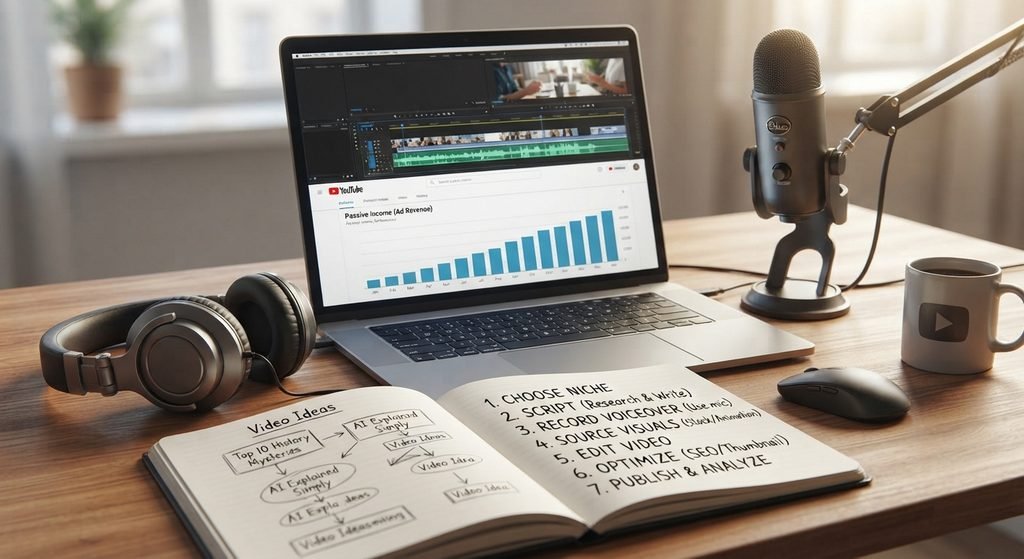
Monetization Paths for a Faceless YouTube Channel
Income typically increases over time and is not from a single source. The most popular revenue source is YouTube Partner Program ads when channel subscribers and watch time reach the required level. This by itself is generally not enough to produce much income early on, but over time as a channel develops.
One of the most popular types of content that affiliate marketing thrives on is informational or review-based content. A natural product description, or tool suggestion, or resource link in a video description can provide a consistent commission without the need for someone to pitch it on video.
Sponsorships will follow when there’s an existing audience for a channel. Brands don’t necessarily care so much about whether or not a creator is on camera, and more about whether the content is reaching the right audience at the right time.
A popular approach is to sell products on the channel, such as templates, guides, or courses, that align with the niche of the channel, particularly for educational or how-to channels.
Realistic Expectations Around Passive Income
Passive is kind of a misleading term in the beginning. Creating a faceless YouTube channel requires actual, active work up-front, script, recording, editing, and publishing regularly for months before earnings are seen. The long term value of published videos is what becomes more passive.
Older videos can continue to get views and earn ad income for a long time after they are posted, particularly if they focus on a timeless content idea that users are still searching for.
It’s at this point that a faceless YouTube channel begins to look more like passive income, not that the work stops, but that the work continues to pay off long after it’s published.
Frequent Growth Inhibitors
One of the most frequent problems is the lack of consistency in uploading, as algorithms are more responsive to regular schedules and audiences. When a company fails to conduct research on what people are actually looking for, they end up with content that seems great, but doesn’t get much traffic.
Titles and topics are just as important as production quality!
It can also hinder production to over complicate things to start off with. An ambitious, complicated format that takes so long to create that uploads become rare, is worse than a simple consistent one that actually gets published.
Start With Focusing On Simplicity
The simplest method to become a faceless YouTube channel is to select one simple format, one clear niche, and publish a small amount of videos before evaluating the results. The perfection from the start is not the most important thing, it is consistency and wanting to get better with each upload.
If you’re willing to put in the time and the work, a faceless YouTube channel can be a true means of generating income, operating in the background until its creator is ready to hit the camera.