

When creators are evaluating platforms, the one thing they typically want to know is. Which platform offers a higher payout? In 2026, with Bilibili expanding internationally, the topic of Bilibili vs YouTube creator earnings has become relevant.
Although YouTube has a well-established monetization system, Bilibili has various other means for creators to monetize through incentives, fan support, or brand partnerships. The actual answer relies upon the quantity of your audience, the niche of your content, interactions, and the way that money making system works on each platform.
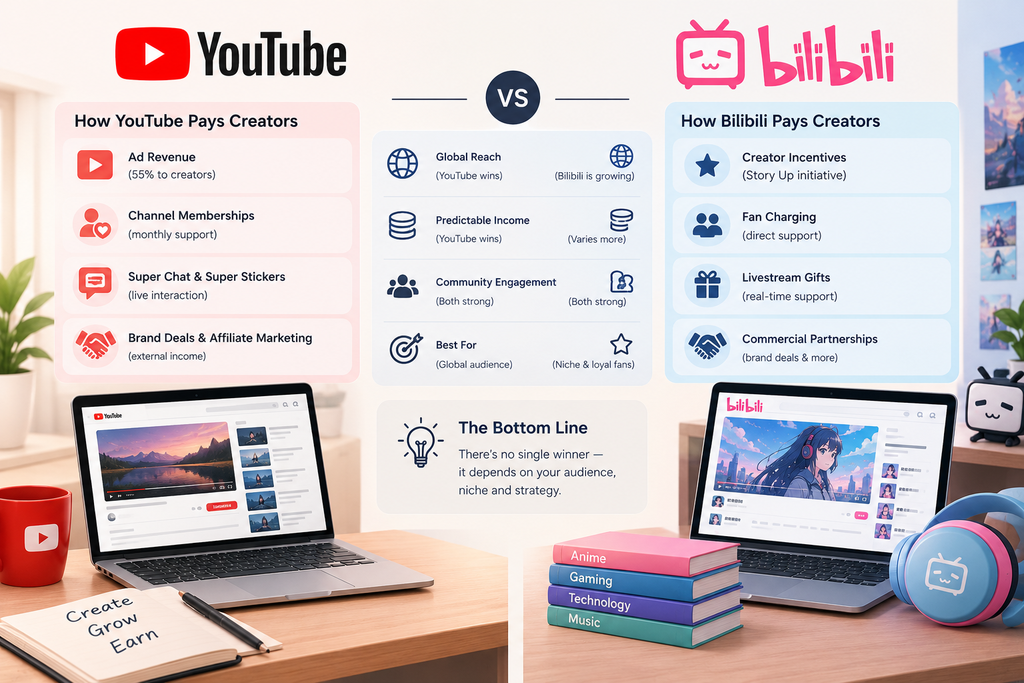
How YouTube Pays Creators
Among the most well-known creator monetization programs in the world is that of YouTube. Advertising is the primary source of income for many creators. But there are other ways of making an audience a viable income source on YouTube.
Eligible creators typically earn 55% of the ad revenue from ads shown on their watch pages for long form videos. Revenue varies based on audience geography, advertiser demand, video subject matter, viewership and number of monetized views.
The YouTube Shorts have a separate monetization system. Creators receive 45% of the revenue allocated to them from the Shorts creator pool. This means, that Shorts earnings won’t be as calculated as advertising on particular long form recordings. Some other features like fan funding (Super Chat, Super Stickers) and channel memberships are also a way to make money.
Outside of the YouTube payment, additional income from brand sponsorships and affiliate marketing can be had. This is appealing to creators seeking multiple revenue streams on YouTube. The platform also offers comprehensive analytics, helping creators to identify their revenue sources and which content resonates most with their audience.
How Bilibili Pays Creators
Bilibili adopts another way of monetizing creators. It has multiple revenue streams, not relying solely on ads, but on the contents’ performance and engagement with the audience. It has been related to the Story Up incentive system for its creation. Factors like video performance, engagement, and advertising related to the content creator’s videos can all affect the payments.
It is generally accepted that creators’ earnings are at about $0.70 per 1,000 views. However this should not be taken as an Official or Guaranteed rate. Earnings vary greatly from creator to creator, content type to type, audience to audience and monetization method to method. There’s also a cash incentive aspect to Bilibili which is said to cap out around $278 per month.
Notably, this isn’t the full revenue a creator can generate with the platform. Fan charging, livestream gifts, commercial partnerships, and more are other ways creators can monetize their content. These sources can be more relevant for creators who have a very engaged audience, than it is to reward them on the basis of views.
So it is essential to pay attention to Bilibili vs YouTube creator earnings, don’t just look at the earning per 1000 views. It’s far more important which is the overall monetization ecosystem.
Bilibili vs YouTube Payouts
The main distinction between the two systems is that the systems of monetization are different. YouTube is in general more predictable. It has a well-defined advertising revenue system and creators understand the advertising revenue process. Channels can see their advertising revenue (views) surge when they build their views and draw in good audiences.
Bilibili is multi-dimensional. A creator can mix platform rewards with fan charging, livestream money, and sponsorship. This can bring several chances for content creators who have a robust group following their content. For instance, if the creator has a lot of passive view counts, then the ad model from YouTube is more beneficial.
However, a creator with a smaller but highly loyal fan base may be able to make good money based on Bilibili’s fan support features. This is why there is no definitive answer in the debate between Bilibili and YouTube creator earnings. The superiority of the two platforms much hinges on the creator’s niche, audience, place, and monetization method.
Audience Size and Global Reach
One of the other significant differences between the two is their audience size. It has an incredibly large global audience, and is accessible in a wide variety of countries and languages on YouTube. This opens up opportunities to reach audiences from virtually all key markets.
However, while the audience of Bilibili is large, it does not have a large scale globally. It stated it had over 376 million monthly active users in early 2026. It has always had a strong community in the anime, gaming, entertainment, technology and Chinese language areas. The more people who see you, doesn’t necessarily mean the more money you’ll make.
It provides more avenues to develop views, attract advertisers, sponsor and have an international following. If you’re creating content for English speakers, YouTube would obviously be your first choice for potential views. The situation can be very different for creators who make content in Chinese or that’s very similar to Bilibili’s community.
Where Bilibili Can Win
For creators, Bilibili might be an appealing platform especially if their niche is already well-established on Bilibili. All kinds of anime, gaming, technological, music, entertainment and educational content can be well integrated in Bilibili’s ecosystem. Knowing what is appreciated by the audience can help the creator build a stronger connection with them. Especially involvement of the audience is crucial.
You don’t necessarily have to be the biggest possible audience if the audience is very engaged and willing to financially support the creator. Fan charging and livestream gifts can help to establish direct connections between creators and fans. This is an opportunity to make more than traditional advertisement.
Bilibili’s international expansion further piques creators’ interest in the platform. They wish to build their presence on an emerging service. A very mature platform may offer a wealth of opportunity. You may find that being in a developing creator ecosystem can present some opportunities that are not readily available.
Where YouTube Still Wins
For most creators, the benefits of YouTube are still the better option when it comes to consistent and scalable advertising revenues. It has a reach across the globe to which no other one can match. A creator has the ability to create content for viewers in various countries for the advantages of YouTube’s advertising infrastructure.
The platform additionally has a fully-fledged ecosystem of analytics and monetization tools. Creators will be able to monitor their watch time, audience retention, traffic sources, ad performance and other key metrics. YouTube also has a variety of advertising-free methods of monetizing your videos.
The different income streams that can come from membership, livestream features, sponsorships, affiliate marketing and merchandise can all fall under a creator’s income. For an absolute beginner, this it’s a more user-friendly environment to develop a creator economy on YouTube.
Which Platform Pays Creators More?
Pays more in the sense of what?
In terms of guaranteed ad revenue and international scalability, YouTube tends to be on top. Its huge user base and established ad system provides creators with great potential for earning.
However, in terms of community-driven monetization, it gets more interesting with Bilibili. For creators with a dedicated and engaged fan base, fan charging, livestream gifts, sponsorships, and other direct audience support options can be advantageous.
Thus, the Bilibili vs YouTube creator earnings can’t be seen as a race between the two earnings rates. There’s a lot more involved in a creator’s total income than views. The amount of views can result in vastly different outcomes and results depending on the audience, niche, engagement, demand for ads and the creator to monetise beyond platform advertising.
Creators’ Smart Strategy.
Creators don’t necessarily have to pick one platform. For some creators, it might be better to use YouTube as the main platform and try out Bilibili as an experiment. Often existing content can be adapted, translated or edited for another audience.
For instance, if the technology creator has a detailed tutorial in English published on YouTube, they can go over it again in the localized version on Bilibili. A gamer could publish highlights on both platforms, and tweak the titles, descriptions, and presentation, to each audience. This can help you create opportunities without a complete new content strategy.
It can also take away the reliance to one platform. If a creator has an audience on other platforms, it can help to offset the impact of changing advertising rates, or if the platform’s algorithm impacts a creator’s reach.
Final Thoughts
There’s no universal answer to the Bilibili vs YouTube creator earnings debate. However, YouTube has a wider, worldwide reach, advertising frameworks, foreseeability and long haul scaling. The thing about Bilibili is that it presents an alternate opportunity for creators whose content resonates with its active user base and who can cultivate devoted followers.
YouTube is probably going to stay the higher primary income platform for most creators aiming for worldwide. But it can be an interesting secondary platform, and Bilibili might prove to be particularly useful for creators of game content, anime, tech, entertainment and Chinese language content.
In the end, it’s not about the platform that offers the best pay, it’s about cultivating an audience that appreciates your content. When it comes to the long run, it may be more important to stick around with the same audience, have multiple revenue streams and be consistent with content than the two platform payment rates.